
30 Delicious Korean Foods You’ve (Probably) Never Heard Of
Korean Cold Noodles Dishes
12. Makguksu (막국수) – Makguksu is a specialty of one of Korea’s food capitals, Chuncheon (in Gangwon Province). It’s very similar to naengmyeon in that they are both buckwheat noodles, but that’s where the similarities stop. Some consider Makguksu noodles to be “rougher,” and some like the radish-kimchi soup base better, too. Go to the makguksu museum in Chuncheon (approx. 1 hour from Seoul), or find it as a side dish at your local bossam restaurant.
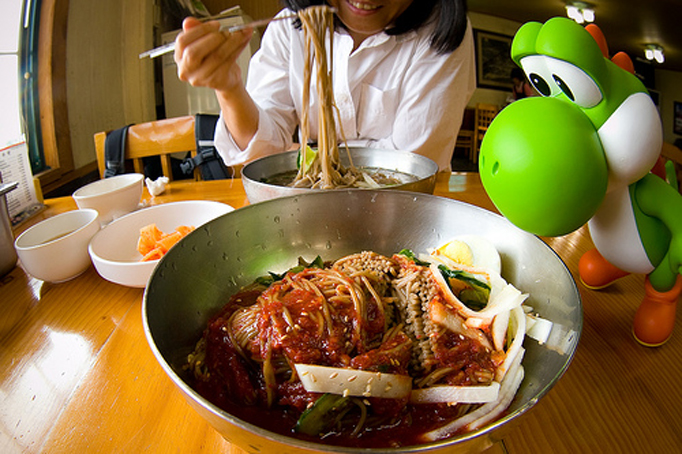
13. Kimchimariguksu (김치마리국수) – cold kimchi noodle soup – Ooo, this Korean noodle dish is so clutch on a hot summer day. Combine two extremly awesome things from naengmyun (cold, icy broth) with kimchi (it’s kimchi, enough said!), and you get kimchi mari guksu. This extremely refreshing cold noodle dish should be a must for naengmyun lovers. Two popular Korean chain restaurants, New Village Restaurant (새마을식당) and School Food have good kimchi mari guksu. (Click here for image)
14. Kongguksu (콩국수) – cold soy milk noodles – This is one naengmyun alternative that is popular for those that love soy. People enjoy the thick milky soy broth along with the delicious noodles. This dish is perfect for vegetarians in Korea. If you’re looking for a famous restaurant to eat kongguksu, try Myeongdong Gyoja.
Watch this great video about Myeongdong Gyoja from Seouleats.com.
15. Jjolmyeon (쫄면) – chewy cold noodles – Jjolmyeon is a favorite for students for its chewy texture and refreshing, spicy taste. The noodles are thicker and chewier than naengmyeon and are mixed with gochujang (chili paste), vinegar, sugar and other vegetables. Sometimes jjolmyeon can be pretty spicy, but if you’re up for the challenge, this dish can commonly be found at bunshik (Korean snack food) restaurants (think restaurants that sell tteokbokki and fried snacks). (Click here for image)
→ Next Page





29 Comments
Actually gamjatang is not potato stew. Gamja stands for the cut of the meat not the potato itself.
Jesse that is incorrect, gamja means potato in korean, and tang means soup in korean. so gamja tang is appropriately potato soup/stew. please do not spread misinformation like that.
You’re right but, there is a theory you didn’t know.
Pig’s backbones, one of the main ingredient of ‘gamjatang’, was called ‘gamjappyeo’ or ‘gamjeo(甘猪)’ in the past. As you know, ‘gamjappyeo’ and ‘gamjeo’ are similar with ‘gamja’ in their pronunciation.
Han and Jesse are right. The original gamja tang did not contain potatoes and some places still don’t use potatoes.
Actually I knew of all of them. My favorite is gamjatang
http://www.youtube.com/watch?v=ejW_UtYdSss
Actually what Jesse said is true. The cut of the meat is actually called kamja. lol.
I am fluent in Korean and I am dating a Korean (3 years).
Ask a korean if you are not sure
Also, you can get kamjatang without potato in it =)
… Also it’s not 덥밥, it;s 덮밥. Sorry!
… 누룽지^ ㅠㅠ
You are correct! Edited to reflect your corrections. Thanks everyone! 🙂
It feels good to know that I have eaten as well as made majority of these delicious Korean food at home. Korean food is very healthy and because of that, I am able to maintain my top physical shape. ^^
Nice Chris, glad it’s keeping you healthy! You’re a K-food expert 🙂
http://lmgtfy.com/?q=%EA%B0%90%EC%9E%90
Erica, try again.
The 감자 in 감자탕 refers to the 감자뼈, which is the cut of meat that is in the dish. @J: Try again, look up 감자뼈.
Jesse, all you did was replace the word soup with the word bone. There are both potato (usually), and bone in that soup. This seems like a common misconception, and probably was the way it has been called for years (with or without the potato). (Much like how ramen means pulled noodles, even though they are rarely hand pulled now.) Though that doesn’t mean it is correct. In fact I went to eat this the other day and specifically asked the lady this question, she said gamja means potato. It doesn’t get much clearer than that.
Here’s another example: gamja jorim. Guess what? gamja is potato, and jorim is the cooking/prep method. Are you telling me gamja jorim is actually some sort of bone side dish? Seems like it isn’t.
The facts are that gamja means potato, and i’m not seeing any exception. Maybe there is an exception, but you haven’t show me. Please show me otherwise. Also, yes I can read korean.
Actually historians disagree on whether the 감자 in 감자탕 refers to potatoes or a particular part of the pig. So both theories could be true.
J, you do know that words can have several meanings, right? ^^ The most common meaning of 감자 is potato, but the part of the pig that is used in 감자탕 is commonly referred to as 감자뼈. Whether it was always called 감자뼈 is something historians can’t agree on. Some think that it took on the name 감자뼈 because it was always being used in 감자탕. No one knows for sure.
I am a Korean native speaker, for what it’s worth.
Yea I understand. I speak chinese as well and we often have simliar words/phrases, that can mean completely unrelated things, or the once-used-for-this-situation-now-always-used-regardless-of-logic words/phrases.
I guess calling it a potato bone because it’s commonly used in that dish seems pretty reasonable. I just hope people know that the actual bone used isn’t a “potato bone” but the 등뼈, and occasionally the 무릎뼈 and possibly others depending on the shop. The shop I frequent uses a lot of 무릎뼈.
I always eat the italian version of (육회) , carppaccio. I loove raw beef
korean usually eat page 3. #12 Makguksu (막국수) after eating Dakgalbi(Spicy Grilled Chicken) as main meal !! <3 so delicious ^.^
Why does Korean still eat raw beef? Japanese use to eat raw beef but then people die from eating it. The raw beef in Japan got ban for having on the menu. There no cure for raw beef if you get sick or about to die.
I feel so hungry now.. ^^
btw there are some mistakes. 김치마리국수 -> 김치말이국수, and 계란마리 -> 계란말이.
one question: What am I supposed to do, when I get a soup and one bowl of rice? I mean, shoud I put the rice into the soup, stir it ad then eat, or eat one spoon of the soup and then rice, one spoon of the soup and again rice?
hi guys, big fan of Seoulistic.com … recently saw a popular singapore blogger copying THIS PARTICULAR article wholesale without crediting. not sure what i should do, so just letting you know.
Hi thanks for letting me know! If you could email at [email protected] the specific blog. I don’t mind reposting, but would like to kindly ask for crediting 🙂
육회 너무 맛있어 보인다!!!
hmm I have heard off some off these and i love Yukhoe, sometimes at school i’ll just by raw beef and eat that during my lunchbreak even though my friends can’t stand it (most of them are vegans)lol
j, jessie, Shut up!!
Is it strange that I know all of these? They aren’t too uncommon.
Can someone please explain what the GAMJA means in GAMJAtang. It is still very unclear to me what this soup consist of. Maybe ask J and Jessie to help again? Ps. I am an English native speaker if that helps. Thanks ㅜㅜ ㅎㅎㅎㅎㅎ lolol