
Text in Korean Like a Pro with Korean Texting Slang!
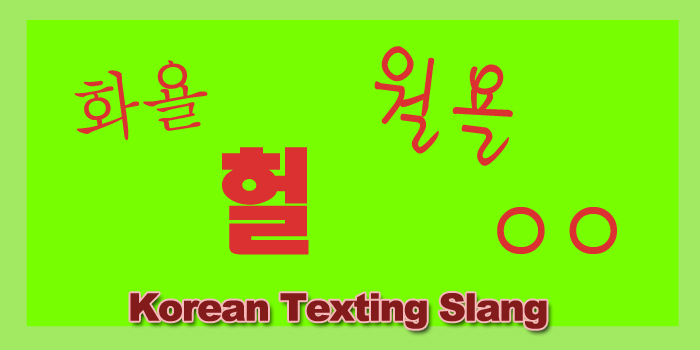
If you’re coming to Korea, you will probably have plenty of opportunity to text in Korean. But even if you don’t care to learn how to text in Korean, these little Korean texting slang tidbits will do wonders in understanding your Korean friends via text. Learn these Korean texting slang, and you just might make your Korean friends chuckle 😉
헐 (heol)
This Korean slang term doesn’t necessarily have a meaning. It’s mostly used to express a mild shock or surprise and at times disappointment. This is mainly used as a non-positive response.
Korean texting example #1:
A: 어디야? (Where are you?)
B: 집, 왜? (Home, why?)
A: 헐… 만나기로 했잖아 (heol, we were supposed to meet)
Korean texting example #2:
A: 머리 밀어버렸어! (I shaved my head!)
B: 헐… (heol)
Korean texting example #3:
A: 비둘기 먹었다!! (I ate pigeon!!)
B: 헐… (heol…)
Note: This texting slang is age sensitive. It is spoken (mostly by very young people), but 헐 (heol) can be seen in Korean texts used by people up to their late 20’s.
ㅇㅇ aka 응 (eung) – Ok/yes
Many Korean texters like to use the least amount of finger movement as possible. And this is totally true with the Korean word for yes/ok, 응 (eung). Instead of wasting precious energy by typing the extra vowel ㅡ (eu), people just omit it totally and text ㅇㅇ.
Korean texting example #1:
A: 밥 먹었어? (Did you eat?)
B: ㅇㅇ (yes)
Korean texting example #2:
A: 빨리 와! (Hurry and come!)
B: ㅇㅇ (ok)
ㅋㅋ (kk) vs ㅎㅎ (hh) vs 푸하하 (puhaha)
The equivalent of “haha” or “hehe,” people use ㅋㅋ (kk) or ㅎㅎ (hh) to not necessarily show real laughter but more as a text filler to make their texts in Korean friendlier or lighter. But if someone manages to make a super hilarious joke via text, many people use 푸하하 (puhaha) to show that there is actual laughter (or at least giggling) going on.
Korean texting example #1:
A: 학교 안 갔어 ㅎㅎ (I didn’t go to school haha)
Korean texting example #2:
A: 나랑 밥 먹을래? (Do you want to eat with me?)
B: 음.. 별로 ㅋㅋ (Umm.. not really haha)
Korean texting example #3:
A: 나 오늘 요리해줄까?? (Should I make you food today?)
B: 푸하하 됐어 (puhaha no thanks)
월욜 (weolyol) = 월요일 (weolyoil)
This is the Korean texting equivalent of shortening “Monday” to “Mon” which is always useful for all the world’s lazy Korean texters. This can be used for any day of the week, essentially the latter part of 요일 (yoil) is shortened to 욜 (yol).
Korean texting example #1:
A: 월욜 만날까? (Should we meet mon?)
B: 목욜 보자 (Lets meet thur)
Have any more Korean texting terms to add? Feel free to add in the comment section!





17 Comments
I’ve encountered with so many more!!! Like, uh… For all the ㅆ in the past tense they would shorten it to ㅅ.
Like 했어 -> 햇어 / 갔어-> 갓어
And other most common short forms I’ve always seen:
영화 봐 -> 영화 바
…이잖아 -> …이잔아
때문에 -> 땜에
너무 -> 넘
And they make their texts cute by ending with many ㅇ and ㅁ s..
Like 오빤 밥먹었엉?? Or 아 귀염!!
Omg there’s too many I almost made a blog post here haha 😛
Sandra, write a guest post!!!! hahaha 🙂 Thanks for all the additions
Besides ㅇㅇ people also use ㅇㅋ for OK, ㅇ=o ㅋ=k.
Then… ㄳ for 감사 (감사합니다)
And… ㅂㅂ (bb) for bye-bye! ^^
FYI, speaking of shortening, b (ㅂ) and s (ㅅ) is the most dangerous combination.
ㅂㅅ (becomes ㅄ) and ㅅㅂ is used to insulting. 병신 and 씨발 respectively. :p
Don’t use them since those are very rude. At least now you know when someone use that to you, he/she is pretty upset with you. 🙂
Other ones:
글쿠나 – 그렇구나
일케 – 이렇게
ㅜㅜ – tears for sad face
ㅇㅇ – actually people use it alot but some girls take offense to it if you’re their boyfriend since they think you’re not paying enough attention to them.
please post more korean slang!! I want to learn more haha~ It’s so funny 😀
“비둘기” 잘못 썼는데…”
I’m sorry I don’t have any to add but I want to say that your information is interesting haha
And mostly any Korean info is interesting to me cuz I do not know anything really about Koreans puhaha
they use 울 to replace 우리 if i’m not mistaken. like 울오빠 instead of 우리 오빠. and i’ve also seen something like this: for example if the name is 힘찬, they use 힘차노빠 instead of 힘찬오빠. are these just typos bc they missed that one letter or are these really korean text slang? because i’m still learning and i don’t know mostly anything yet. XD
Hello is there any one who wanna be my friend? 🙂
where are you? ^^
안녕하세요~~~~
I have a question!! I’m chatting with a korean girl on kakao talk-she’s in my ballett class :))
and she wrote “웅웅” what does that means??? please help me. thank you ~~~
웅웅 is similar to 응응 which means yes or i agree. 웅웅 is just a cuter way of saying 응응
Hello I wanna learn Korean language .
What is this means
How are you… Bb
만나기로 했잖아 . translates to ” you were supposed to meet HIM” NOT ” we were supposed to meet” the translation you used was wrong, I’m saying this because I looked at all the translations for this sentence they are the same plus one very important help is my friend who is korean native.
Thanks a lot!
That’s actually useful, thanks! I can say that not so long ago, I started to learn French with Lingopie besides Korean, and there are even more slang words and phrases that can be quite hard to understand. But I’m glad that it’s not a problem to find such useful forums to figure out such aspects and improve language skills.
I was recently passing through Korea. I liked the language and I communicated with the help of a dictionary. But recently I was sent to Vietnam. And I needed a written translation of documents. Thanks to the link https://www.translate.com/vietnamese-english I found a translation agency and in a short time a huge amount of documents was translated for me. Glad to have used these services.